

Lube Oil Flushing Inspection & Documentation Services
Fairtex Group provides Inspection and Documentation services for Lube Oil Flushing Operations, which covers:
- Inspections of flush screens, flush rig filters, and bags.
- Contaminant analysis.
- Gathering key baseline and related performance data.
- Monitoring system improvement.
- Assisting in establishing inspection requirements for lubricant performance and quality assurance.
- Daily communication with key stakeholders following a pre-determined Inspection Test Plan (ITP).
Service Summary and ROI Documentation:
- Completed Steps.
- Performance improvement documentation.
- Additional engineering recommendations for reliability.
- Routine recommendations, e.g., preventative maintenance.
- Decontamination of system piping with turbulent flow.
Our High-Velocity Flushing Services can improve your business by:
- Enhancing equipment reliability and extending equipment life.
- Reducing unscheduled downtime and forced outages.
- Establishing more effective maintenance procedures.
- Increasing flow rates in piping, coolers, and sealing systems.
- Meeting and exceeding ISO cleanliness standards.
- Improving your equipment’s reliability and extending its service life.
- Saving money by reducing maintenance, downtime, and lube disposal.
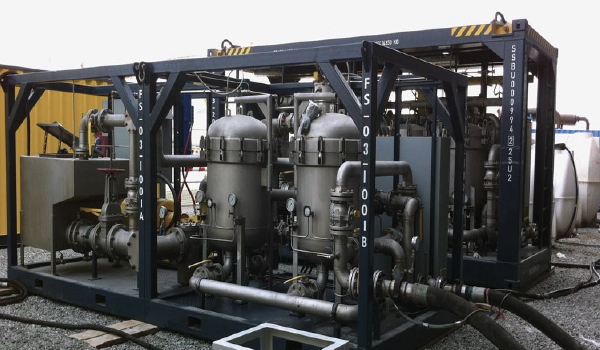
High-Velocity Oil Flushing Skids are used to flush and filter piping systems in power plants, chemical plants, oil refineries, and other petrochemical applications. These pre-engineered, pre-fabricated systems are ready for shipment and include onboard heaters, filter housings, and flow meters.
Our flushing services cover a range of activities, including baselines, monitoring, documentation of steps, and after-action reports. Fairtex Group manages all types of oil flushing projects, utilizing assets such as vacuum dehydrators, high-velocity oil pumps, filter skids, heater skids, VFD panels, high-pressure pumps, and more.
Fairtex Group takes safety, health, and the environment seriously, delivering projects of all sizes safely to meet standards. Our engineers:
- Understand the hazards of handling, storage, and use of petroleum products.
- Coordinate efforts through designated plant personnel.
- Strictly observe site, environmental, and ESI safety protocols.
- Verify equipment electrical and mechanical lockout, proper tagging, and potential explosion hazards before working with equipment.
- Provide recommendations to reduce spillage, leakage, and fire hazards.
We are providing good & on time services to our valuable clients.
Copyrights © 2026 All Rights Reserved Fairtex Nigeria Ltd
Developed & Managed by Padyclub